
Over its 35 years, the Flagstaff Family Food Center has evolved dramatically. What started as a kitchen ultimately added a food bank. Originally local in focus, our services now expand to Leupp, Winslow, and Grand Canyon Village.
Similarly, our mission also has evolved, because it’s not enough just to meet the needs of people facing hunger. We also need to figure out why food insecurity exists and what is needed to change those conditions.
That is the purpose behind our annual Food Equity Report: to assemble reliable data that decision makers can point to when making decisions about programs, resources, and policy.
I’m proud to share with you the 2025 edition of this report today.
This is not a feel-good document; it’s a rigorous analysis of the forces shaping food insecurity in northern Arizona with data pulled from more than 450 client surveys, focus groups in four distinct communities, and a close read of the state and federal policy changes now impacting our region.
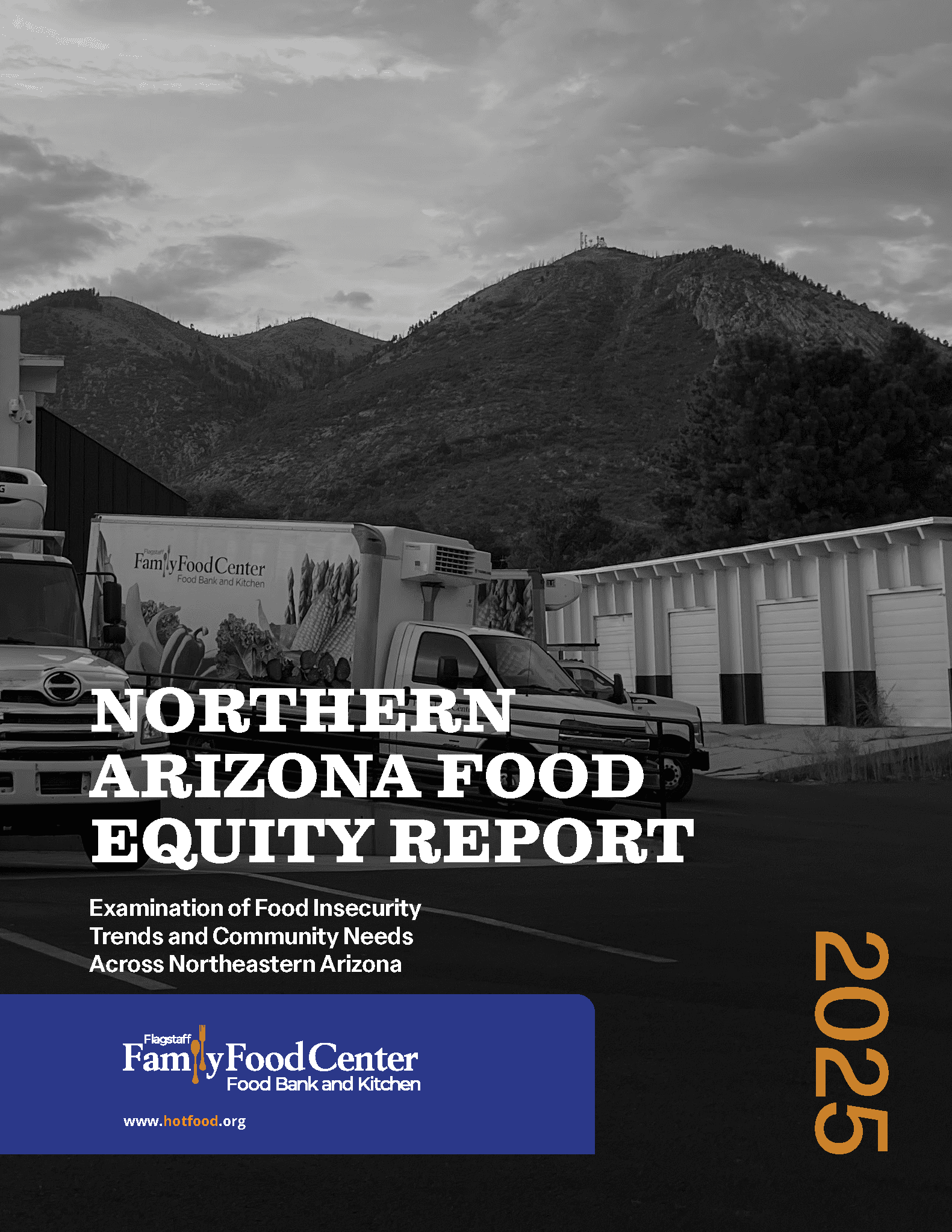
What We Found
While I hope you will all download and check out the full report (it’s colorful, easy-to-read and has lots of compelling infographics), here’s a quick overview of some of the key insights we discovered while doing this study:
1. The need for our services has grown and is likely to increase in the future. FFFC broke its single-day service record six times in 2025, serving more than 374 households in a single day. In 2025 alone, FFFC served 537,972 prepared meals, an 11.3% increase over the previous year. Changes mandated by last year’s federal tax bill – such as new work requirements for SNAP benefits – make it likely more people will rely on FFFC in the coming months and years.
2. Food access must reflect real lives. What causes food insecurity in Phoenix does not reflect what’s happening in northern Arizona, and in fact, the drivers of hunger can be significantly different within our region. In Flagstaff, high housing costs and inflation often are the main culprits. On the Navajo Nation, there are less than 14 full-scale grocery stores in an area that exceeds 27,000 square miles. Meanwhile, workers at the Grand Canyon in employer provided housing often don’t have access to a kitchen, and no retailers in the area accept SNAP benefits. Our region defies simple, one-size-fits-all solutions.
3. Food choice isn’t a luxury, it’s a necessity. When someone doesn’t have refrigeration, fresh produce isn’t a benefit – it’s a burden. For someone managing diabetes, being able to select food ensures it fits their health needs. When someone lives in a vehicle or a dorm room, bulk dry goods may be completely unusable. Expanding the ability to choose the food your receive is essential to making food assistance actually work.
That’s just a little of the insights you’ll find in this report. I hope you’ll take the opportunity to read it, because seeing this issue clearly and appreciating all of its complexity is necessary if we are going to successfully address it.
The work of ending hunger here is long. It’s requires all of us. But it is possible and it starts with understanding.

If you’d like your business to become part of our work, please reach out and let’s find a way to get your team involved.
Sincerely,
Ethan Amos
President & CEO
‘Stuff the Bus’ Returns Nov. 8th & 9th
We are proud to partner with Mountain Line, the City of Flagstaff, and Coconino County for our 10th annual Stuff the Bus food drive on November 8 and 9, 2025.
Resilience on the Rim
The Grand Canyon food pantry was founded during the last major shutdown in 2018–2019, and supports hundreds of households each week.
Our First Neighbor – George McCullough
The very first neighbor who embodied our mission of Neighbors Feeding Neighbors, Every Day was the man who started FFFC almost 35 years ago, George McCullough.
